
This article first appeared here
Palmer Luckey’s defense startup is everywhere now. And that is exactly the problem.
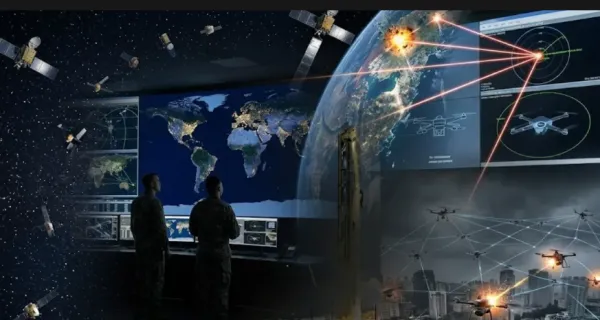
In the span of a single news cycle, Anduril Industries announced it is leading a team to build space-based weapons for the United States Space Force, embedded its drone defense systems into NATO infrastructure in the Netherlands, and unveiled a subscription-based private cellular network it wants to rent to the military for battlefield communications. Three announcements. Three new sectors. One company. One software backbone running through all of it.
This is not a disruption. This is an occupation.
Anduril was founded in 2017 by Palmer Luckey, the entrepreneur who built Oculus VR, sold it to Facebook for $2 billion, and was subsequently fired. He pivoted to defense with a stated mission to challenge the legacy defense contractors — Lockheed Martin, Northrop Grumman, Raytheon — that he and his Silicon Valley backers argued were too slow, too expensive, and too entrenched to build what the modern military actually needs.
He was not entirely wrong about the problem. He has built something far more dangerous than the solution.
The Space Weapons Contract
Earlier this month, Anduril announced it is leading a team of industry partners under contract with the U.S. Space Force to develop space-based interceptors — weapons designed to destroy enemy missiles from orbit — as part of President Donald Trump’s Golden Dome initiative.
The Space Force awarded 20 Other Transaction Authority (OTA) agreements worth up to a combined $3.2 billion to 12 companies in late 2025 and early 2026. OTA contracts exist specifically to bypass standard federal acquisition rules. They move faster. They require less transparency. And they are increasingly the preferred vehicle for moving billions of taxpayer dollars to defense technology companies with limited track records in the mission areas they are being paid to develop.
Anduril’s track record in space is effectively nonexistent. The company builds drones and surveillance systems. What it has not done, at any documented scale, is build, launch, or operate weapons systems in orbit. That did not stop the Space Force from handing it a contract to do exactly that — with a deadline of 2028.
The broader Golden Dome program is projected to cost $185 billion. The gap between what has been funded and what the program is projected to cost is not a rounding error. It is larger than most countries’ entire defense budgets. And at the center of it, collecting a piece of $3.2 billion, is a company that has never built a space weapon.
Space Force Gen. Michael Guetlein, the Pentagon’s top Golden Dome official, told a House Armed Services subcommittee in April that affordability is the program’s central concern. “If we cannot do it affordably, we will not go into production.” That is not the language of a program on track. That is the language of a program quietly preparing its exit ramp — while the contracts are already signed and the money is already moving.
The European Foothold
The same week, Anduril announced the Dutch Ministry of Defence had awarded it a contract to deploy counter-drone defense systems across the Netherlands. The company led with a single headline claim — it moved from contract signature to initial operating capability in under one month.
That timeline is supposed to be impressive. It should be alarming.
Defense procurement exists the way it does for a reason. Oversight. Testing. Independent validation. The slow process that Silicon Valley loves to mock is the same process that catches flawed systems before soldiers depend on them in the field. Anduril did not describe what initial operating capability actually means in the Dutch context. It did not specify how many systems were deployed, what was independently verified, or what happens if the systems fail.
What it did say is that the Netherlands should be a model for how NATO procurement works going forward.
Anduril’s Lattice software — its proprietary command-and-control platform — is now embedded in Dutch air defense infrastructure. That means an American private company’s proprietary software sits at the center of a NATO member’s ability to defend its own airspace. The alliance-wide interoperability implications of that arrangement have not been publicly discussed. The oversight mechanisms have not been disclosed. The contract terms are not public.
Anduril got its European beachhead. Now it will use the Netherlands as a case study to sell the same architecture to every other NATO member currently panicking about drone proliferation. That is not speculation. That is the company’s explicit strategy, stated in its own announcement.
The Communications Takeover
If the space weapons contract and the European air defense deal were not enough, Anduril this week also unveiled the 5G Comms Sentry Tower — a deployable private cellular network it wants to embed in military operations worldwide.
The pitch is that the existing communications infrastructure fails in remote military environments, and Anduril can fix it. That part is true. The problem is how.
The 5G CST is not sold to the military. It is rented. Anduril delivers it as a service, with customers paying for network access on a subscription basis. That means the United States military does not own the communications backbone connecting its soldiers, sensors, and weapons systems in the field. It leases it. From Anduril. For as long as Anduril decides to keep offering the service, at whatever price Anduril decides to charge, with whatever terms Anduril’s lawyers write into the next contract renewal.
The system runs on Lattice. Everything Anduril builds runs on Lattice. That is the point.
Lattice is Anduril’s proprietary command-and-control software. It ties together the surveillance towers on the border, the drone defense systems in Europe, the space-based interceptor architecture, and now the battlefield communications network. Every new contract embeds Lattice deeper into government and military infrastructure. Every new system makes the next one harder to refuse — because walking away from Anduril means dismantling everything built on top of Lattice. That is lock-in. In the commercial technology world, it is a business model. In national defense, it is leverage over the institutions responsible for protecting the country.
The Architecture of Dependency
Step back from any individual contract, and the shape of what Anduril is building becomes clear.
Surveillance of who enters the country. Control of the airspace above allied territory. Communications infrastructure connecting forces in the field. Weapons systems orbiting the Earth. Each piece is announced separately. Each one is framed as a solution to a specific, legitimate problem. Each one runs through the same privately owned, proprietary software backbone controlled by a single venture-backed company founded by a man who was fired from his last job.
Anduril now has over 400 towers deployed globally. It has contracts with the U.S. military, ICE, the Department of Homeland Security, and NATO allies. It is embedded in space defense, air defense, border security, and battlefield communications. It is not a contractor. It is becoming infrastructure — the kind of infrastructure that, once embedded, is nearly impossible to remove without dismantling the systems that depend on it.
Unlike the Pentagon’s own systems, which are subject to congressional oversight, inspector general reviews, and public accountability, Anduril’s infrastructure is proprietary, privately held, and answerable primarily to its investors. The public cannot audit Lattice. Congress has not held a dedicated hearing on Anduril’s expanding role in national defense infrastructure. No federal agency has publicly assessed the national security implications of a single private company embedding its software at the center of military operations across multiple domains and multiple allied nations.
The legacy defense contractors that Anduril set out to disrupt are bloated, slow, and expensive. That critique was fair. But they are also publicly traded, heavily regulated, subject to decades of oversight mechanisms, and structured in ways that limit how much any single company can control. Anduril is none of those things — and it is growing faster than the oversight designed to keep it honest.
The Question Nobody Is Asking
The drone threat is real. The communications gap is real. The missile threat from near-peer adversaries is real. The urgency Anduril sells in every press release is not manufactured from nothing.
But urgency has always been the defense industry’s most reliable tool for moving money before the hard questions get asked. And the hard questions here are not small ones.
What happens when Anduril’s space-based interceptors miss the 2028 deadline? What happens when the Lattice system in a NATO ally’s air defense network goes down during a crisis? What happens when the military’s battlefield communications — rented, not owned, from a private company — become a point of leverage in a contract dispute? What happens when the company that controls the architecture of American war decides its shareholders come first?
Alonzo Sawyer, wrongfully arrested after a facial recognition algorithm flagged him as a suspect, asked the question that applies here, too.
“I knew I was innocent,” he said. “So how do I beat a machine?”
For the American military, for NATO allies, and for the public paying for all of it, the question is the same. When the machine is Anduril — when it controls the surveillance, the communications, the air defense, and the weapons in orbit — how do you beat it?
Nobody in Washington is asking. Anduril is counting on that.